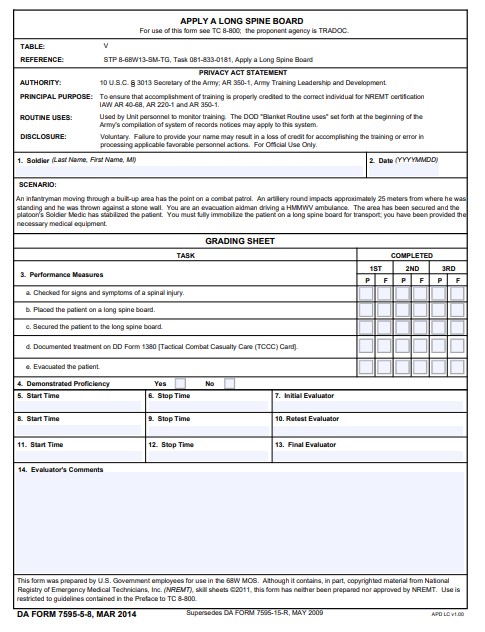
What is DA Form 7595-5-8? It is the Department of the Army form titled Perform Spinal Immobilization: Long Spine Board, and it exists so that you can apply a long spine board. That single line covers most of what people arrive looking for. The rest of this page fills in the details.
Which edition is on this page? The one dated March 2014, status not stated. On army forms the edition date is the version, printed on the page itself so any copy can be checked.
Who fills it out, and how long does it take? The individual named in the entries fills it, or a records clerk fills it on that person's behalf. Length is 1 page(s) with about 148 entry fields, which is the honest measure of the work involved. Who owns the form and when it is raised comes from TRADOC and TC 8-800 respectively.
What the form asks for
- A_1_F
- A_1_P
- A_2_F
- A_2_P
- A_3_F
- A_3_P
- B_1_F
- B_1_P
- B_2_F
- B_2_P
- B_3_F
- B_3_P
- C_1_F
- C_1_P
- C_2_F
- C_2_P
- C_3_F
- C_3_P
- ContentArea1
- DATE
- D_1_F
- D_1_P
- D_2_F
- D_2_P
Download the form
What can I download here? The formats available are PDF, XFDL. Each one reproduces the identical official layout. What separates them is the method of entry, nothing on the page itself.
Fillable or printable — which do I want? Fillable, if there is a keyboard involved: the boxes are interactive objects that store text. Printable, if there is a pen involved: the boxes are just lines on paper. Nothing else distinguishes them.
Do I need special software? Not for reading — a pdf opens in the browser you already have. For filling, install a full pdf reader rather than trusting the in-browser viewer, which sometimes displays fields it cannot save. Type into one field, save, reopen and confirm the text survived. Why will my xfdl file not open? Because it is IBM Lotus Forms, not pdf. The Lotus Forms Viewer is the only application that reads it.
Does the download cost anything? No. There is no charge, no account and no email address to surrender, and the file you receive is the published document with nothing added to it.
Where do you start? At the top of the page, with the identifying entries: name as your official records spell it, identification number, unit or organisation, date of preparation. Why first? Because those entries are what the form is filed and searched under later, and a record indexed on a misspelled name is a record nobody retrieves.
What is the fastest way to fill the body? Tab from field to field. The order was set at build time and normally matches how the page reads, which is why tabbing catches boxes that clicking past would leave empty. And the boxes and buttons? Those take a click. Where only one option in a set can apply, choosing one deselects the other.
Why does my text vanish when I print? Because one-line fields have no wrap, and anything past the field width is truncated on paper even though the screen shows all of it. Where should the overflow go? Into remarks, or onto a continuation. What about entries that do not apply? Enter the mark meaning "none". Blank space is ambiguous; a reviewer cannot tell an omission from a considered nil.
Where does the signature belong in the sequence? At the very end, by hand or by an accepted electronic means. An unsigned form is a draft regardless of how full it is. Are countersignatures needed? Where the form provides for them — reviewing official, approving authority, witness — taken in printed order and dated on the day applied. What should you check before releasing it? Empty mandatory fields, digit transposition in identification numbers, day-month inversion in dates, and residue from an old copy used in place of a blank one.
Why does the form carry a Privacy Act statement? Because personal information is being collected, and the statement declares the authority, the purpose, who else routinely sees the data, and whether answering is required or optional. Is it worth reading? Read it before you fill the fields it governs, not after. Does it change how you keep the file? It should — a filled copy is a personal record and gets the handling such records receive.
What happens after signing? The form is routed as the prescribing directive requires: to a named office, through the unit administrative channel, or into the personal file. Do you get the original back? No, so make a copy first. Who sets the retention period? The applicable records schedule, not the office holding the document.
Which other forms travel with this one? Those found by series and number: DA series documents sharing a proponent or a governing directive are frequently needed in combination, and a form referenced on the face of another generally accompanies it. Do you assemble them before or after sending? Before. Continuation sheets, cover sheets and transmittals are part of the same package.
When is an edition replaced? When the proponent revises the form and publishes a new edition date. What should you do with a copy kept on your own machine? Check its date against the edition in force before reusing it. Does the change reach backwards? It does not; work already completed on an earlier edition remains valid as filed.
What exactly is this site? A place to download reproductions of published Department of the Army documents. Is it part of the Department of the Army? No — it is independent, issues no forms of its own, and has no authority over any of them. Can it tell you whether your completed form will be accepted? It cannot, and nothing written here is legal advice. Who answers the real questions? TRADOC or the administrative office servicing your unit, on any question of entry, requirement or eligibility.
Questions and answers
- What is DA Form 7595-5-8?
- Perform Spinal Immobilization: Long Spine Board
- Which edition is current?
- March 2014
- Who is responsible for this form?
- TRADOC
- In which formats can it be downloaded?
- PDF, XFDL